We’ve all experienced that feeling of suffocation after exertion, or that shortness of breath during the day for no apparent reason. In the vast majority of cases, the problem doesn’t originate from the lungs but from the diaphragm, the dome-shaped muscle located beneath the ribs that does most of the respiratory work. Strengthening and loosening this muscle significantly changes the quality of each breath, whether at rest, during sports, or in times of stress.
Subcostal Work: The Area Most Routines Ignore
When we talk about diaphragmatic breathing, we immediately think of the belly expanding. The classic reflex is to push the abdomen forward during inhalation. In reality, this approach only engages part of the diaphragm and overlooks the entire lateral area beneath the ribs.
Subcostal work specifically targets this region. Place your hands on either side of the thorax, fingers slipped just under the rib cage. During inhalation, aim to push the ribs outward against the hands, not to inflate the belly. Exhalation is done by allowing the ribs to gently return, without forcing.
Several approaches in physiotherapy and osteopathy also incorporate gentle subcostal massage before exercise: gently pressing under the ribs with the thumbs during a few exhalations to release tension in the diaphragm. This prepares the muscle and improves the range of motion that follows. When looking for exercises to strengthen the diaphragm, this subcostal approach is often the most effective for gaining thoracic mobility.
Supine Diaphragmatic Breathing: The Foundation Not to Neglect
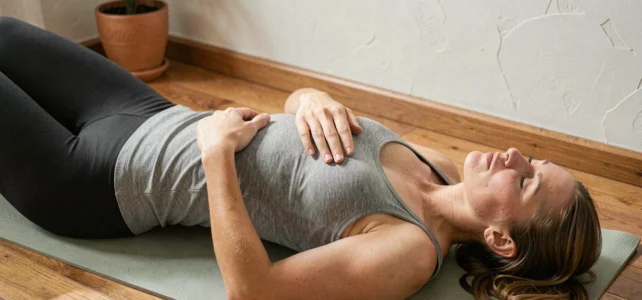
The reference exercise remains diaphragmatic breathing in a supine position. It can be found everywhere, but it is often poorly executed. The most common mistake is forcing the abdomen outward like a balloon, which contracts the superficial muscles instead of engaging the diaphragm deeply.
The correct mechanics rely on a simple principle: the exhalation should last longer than the inhalation. Inhale through the nose, allowing the belly to rise naturally, without pushing. Then exhale slowly through the mouth, feeling the belly lower. An inspiration/exhalation ratio of about one to two works well for most people.
To check that you’re using the diaphragm correctly, place one hand on your belly and the other on your chest. Only the hand on the belly should move. If the chest rises, you’re using thoracic breathing, which means the accessory muscles of the neck and shoulders are compensating.
- Keep the jaw relaxed and shoulders low throughout the exercise; otherwise, the nervous system remains in alert mode, and the diaphragm does not fully relax.
- Start with short sessions; a few minutes are sufficient. Gradually increase the time over several weeks.
- Stop immediately if the exercise causes dizziness or discomfort. Diaphragmatic breathing should never create discomfort.
Resisted Inspiratory Training: Strengthening the Diaphragm Like an Athlete
Most articles focus on relaxation and stress management. They overlook a more demanding angle: the active strengthening of the diaphragm through resistance, used in physical preparation and respiratory rehabilitation.
The principle is the same as for any muscle. You impose a load or mechanical constraint during inhalation, which forces the diaphragm to work harder. Two concrete methods work well in practice.
The first uses an inspiratory resistance device (like PowerBreathe or similar). You set the resistance and inhale through the mouthpiece. The diaphragm must generate more force to draw in air, which progressively strengthens it like a classic weight training exercise.
The second method, more accessible, involves placing an elastic band around the rib cage at the level of the lower ribs. By inhaling against the resistance of the band, you force the respiratory muscles, including the diaphragm, to exert extra effort to open the thorax. Feedback on this point varies: some people find the band uncomfortable at first, while others adapt to it in two or three sessions.

Cool Down and Stress Management: When to Use These Exercises Daily
Knowing how to do the exercises is not enough if you don’t know when to incorporate them. The diaphragm does not respond the same way depending on the context.
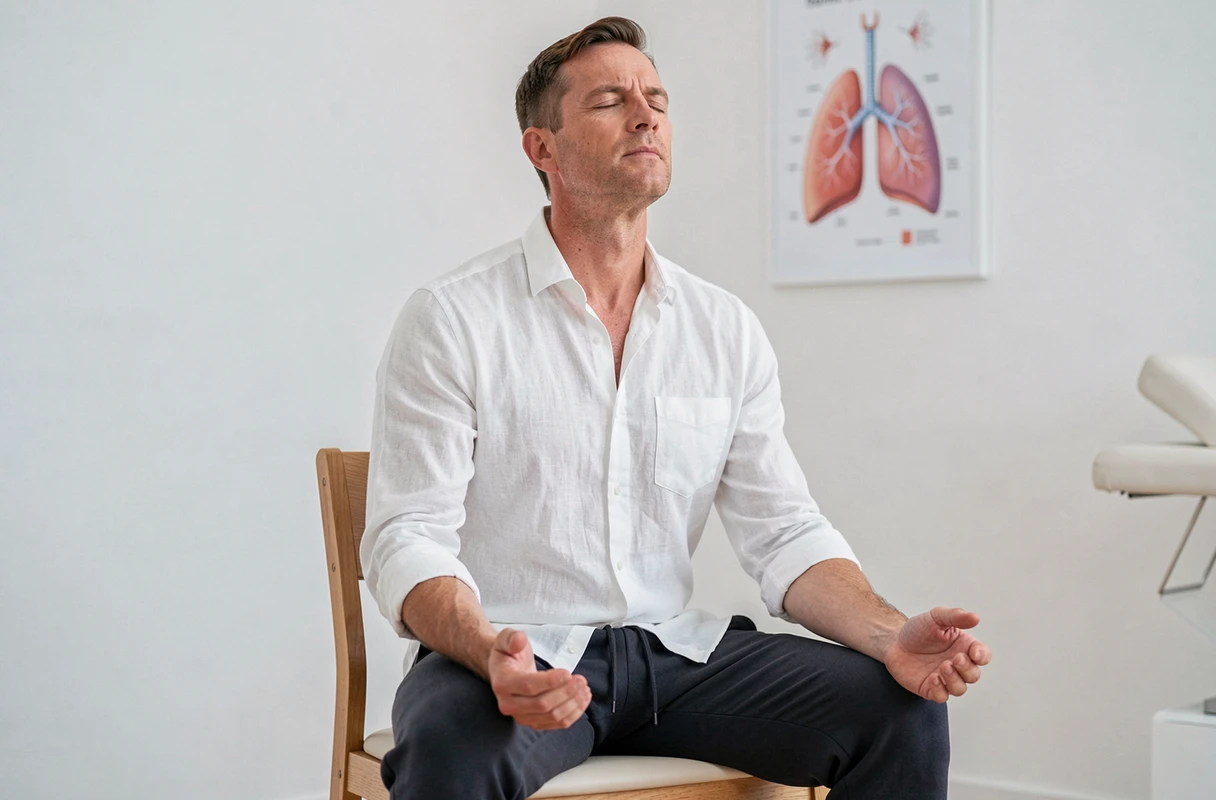
After exercise, diaphragmatic breathing accelerates the cool down by activating the parasympathetic nervous system. You lie down or sit, and follow a few minutes of slow breathing with prolonged exhalation. This lowers the heart rate faster than passive recovery.
In cases of stress or anxiety, the same mechanism applies. The diaphragm is connected to the solar plexus, a nerve hub sensitive to emotional tension. When stress blocks the diaphragm, breathing becomes shallow and thoracic. Practicing a few cycles of diaphragmatic breathing, even while sitting at a desk, often suffices to break this cycle.
- Upon waking: a few minutes of supine subcostal work to mobilize the diaphragm, which may be stiff after the night.
- After a workout: slow diaphragmatic breathing to promote recovery and reduce cortisol levels.
- In acute stress situations: prolonged exhalation through the mouth, consciously relaxing the shoulders and jaw.
- In a regular routine: resisted inspiratory training two to three times a week for gradual diaphragm strengthening.
The diaphragm is both a postural and respiratory muscle. A mobile and toned diaphragm improves trunk stability, alleviates certain lower back pain related to tightness in the psoas and quadratus lumborum, and makes each breath more effective without conscious effort. The most challenging part is not the technique; it’s the consistency.