
The drop and basin warning light on Clio 3 indicates the windshield washer fluid level warning, a standardized pictogram according to ISO 2575. Its shape, a droplet falling into a stylized reservoir, is often confused with other fluid alerts, particularly coolant or AdBlue in recent diesel engines. Here, we detail the precise mechanisms behind this alert and the interventions to consider.
ISO 2575 Standard and Confusion Between Fluid Pictograms on Clio 3
The drop/basin symbol corresponds to pictogram N.03 of the ISO 2575 standard (“Road vehicles – symbols for controls, indicators, and warning lights”). This international standard requires manufacturers to use a standardized design for each dashboard function. On the Clio 3, this pictogram is exclusively assigned to the wash fluid level.
The most common confusion concerns the coolant temperature warning light, whose pictogram represents a thermometer submerged in a fluid. Both symbols share a “liquid” aesthetic, leading to erroneous diagnostics among drivers unfamiliar with the Renault dashboard.
Another source of misunderstanding: on some diesel vehicles equipped with an AdBlue tank, a droplet-shaped warning light may also illuminate. On the Clio 3, this case does not occur (no AdBlue system), but owners switching vehicles sometimes carry this confusion from one model to another. To understand the drop basin warning light on Clio 3, one must first isolate the correct circuit: washer fluid, cooling, or engine alert.
Washer Fluid Level Sensor Clio 3: Operation and Common Failures
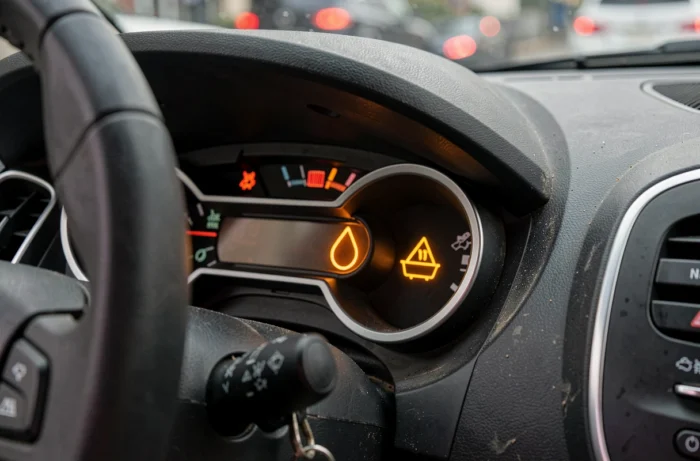
The washer fluid reservoir of the Clio 3 incorporates a magnetic float sensor. When the level drops below the calibrated threshold, the float opens the circuit and the control unit lights up the drop/basin warning light on the dashboard. The system is simple, but several failures are worth knowing.
- Oxidized connector on the sensor: exposure to saltwater splashes in winter corrodes the sensor plug, causing a permanent false contact. The warning light remains on even when the reservoir is full.
- Float stuck by limescale deposits or residues from concentrated washer fluid. The float no longer rises, and the sensor continuously indicates a low level.
- Pinned electrical harness during an intervention on the front bumper or left wheel arch, an area where the sensor wiring runs on the Clio 3.
- Crack in the reservoir itself, usually at the lower weld, causing a slow leak and intermittent illumination of the warning light.
We recommend checking the sensor connector before any part replacement. A simple electrical contact cleaning and rinsing the reservoir with clear water is usually enough to turn off the warning light.
Drop Basin Warning Light and Technical Inspection: What the Regulations Say
A rarely discussed point: a non-functional washer system can lead to a refusal at the technical inspection. Regulations require that any vehicle equipped with a windshield must have a compliant cleaning device. The inspector checks the operation of the nozzles and the presence of fluid.
An illuminated drop/basin warning light during the inspection does not in itself constitute a reason for a re-inspection. However, if the reservoir is empty and the nozzles do not spray anything, the defect is noted. On the Clio 3, the washer pump rarely fails, but a cracked reservoir that empties between filling and the inspection day creates a classic trap.

We also observe that some owners confuse this warning light with an engine fault and postpone the technical inspection out of caution, while the issue is simply a need for washer fluid. Correctly identifying the pictogram avoids this type of unnecessary delay.
Differential Diagnosis: Distinguishing the Washer Fluid Light from an Engine Alert on Clio 3
On the dashboard of the Clio 3, several warning lights can illuminate simultaneously, making visual diagnosis tricky. Here are the distinctions to master.
The drop/basin warning light is orange and static. It does not blink. Its illumination is never accompanied by a power limitation or a switch to limp mode. If the vehicle experiences a loss of power coupled with a blinking orange light, it is the injection/pollution warning light, whose pictogram represents a stylized engine.
The coolant temperature warning light, on the other hand, is red and represents a thermometer. Its illumination requires an immediate stop of the vehicle. Confusing the two can lead to either an excessive reaction (emergency stop for a simple lack of washer fluid) or serious negligence (ignoring an engine overheating thinking it is the washer fluid).
- Drop/basin warning light (orange, static): low washer fluid level, no immediate mechanical danger.
- Thermometer in a fluid warning light (red): engine overheating, immediate stop required.
- Orange engine warning light (fixed or blinking): injection/pollution fault, OBD diagnosis required.
The color code of the warning light indicates the level of urgency: orange signals information or a minor fault, red requires immediate action.
On a high-mileage Clio 3, the simultaneous illumination of the washer fluid light and another warning does not necessarily indicate a link between the two faults. Each circuit is independent. A check with the OBD scanner can clarify any doubts about possible fault codes recorded by the engine control unit, unrelated to the washer fluid system.
The drop and basin warning light remains one of the most benign alerts on the Renault dashboard, provided it has been correctly identified. A sensor costing a few euros, a cleaned connector, or a simple top-up of fluid resolves the situation in most cases. The only costly mistake would be to confuse it with a cooling warning light and ignore a real overheating issue, or vice versa.