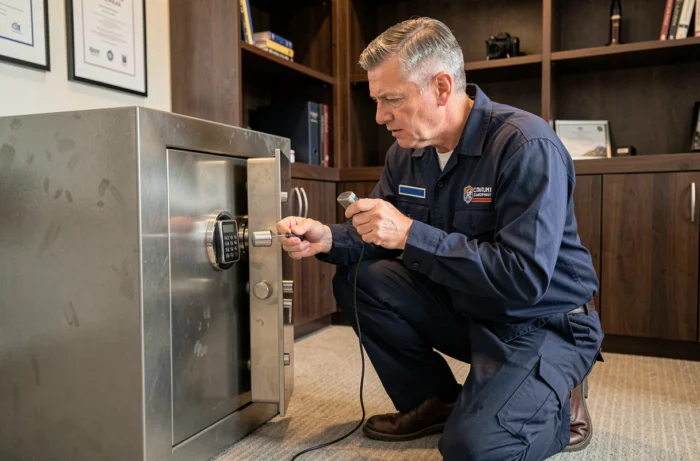
A locked safe places its owner in an immediate dilemma: force the opening at the risk of damaging the mechanism, or wait for specialized intervention while leaving their valuables inaccessible. The malfunction of a safe affects both electronic locks and mechanical key or combination systems, and the causes vary depending on the age of the equipment, its usage, and its maintenance.
Safe Malfunction and Home Insurance: An Often Overlooked Angle
Most guides on a safe being locked focus on the technical gesture. They overlook a crucial question: the insurance coverage during and after the malfunction.
A locked safe no longer protects anything if its owner decides to temporarily move valuable items while waiting for repairs. However, home insurance contracts often condition compensation on the presence of a certified and functional safe. Removing jewelry or cash from a malfunctioning safe to store them elsewhere in the home may, depending on the contract clauses, reduce or cancel theft coverage.
Before any manipulation, checking the conditions of one’s insurer proves more useful than searching for an online opening tutorial. Some contracts even require a declaration in case of a malfunction of the safe, just like any other claim.
For owners considering safe repair with Depanneo, keeping the intervention invoice serves as valuable proof for the insurer, whether to demonstrate the maintenance of the equipment or to document the nature of the malfunction.
Diagnosis of Locking: Electronic Lock vs. Key Mechanism
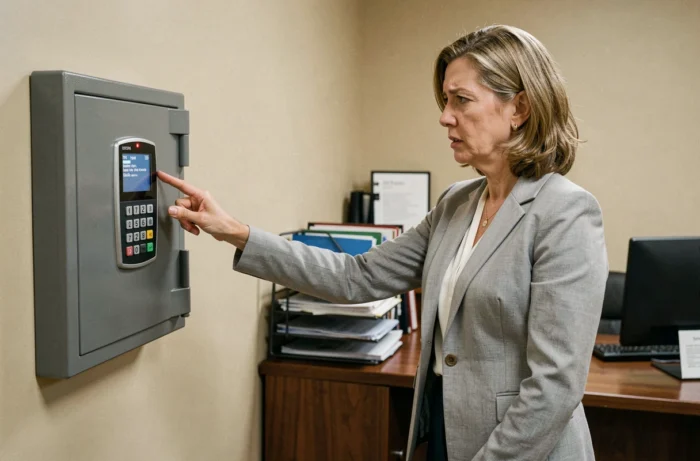
The diagnostic approach differs radically depending on the type of locking. Confusing the two leads to unnecessary, even destructive, manipulations.
Electronic Lock Safe
The most common cause of malfunction in an electronic safe is battery depletion. Most models use standard alkaline batteries, and their lifespan depends on the frequency of use. When the keypad no longer responds or the sound signal weakens, replacing the batteries resolves the issue in a large number of cases.
If the keypad lights up but the code is rejected, several possibilities arise:
- A repeated input error may trigger a temporary security lockout (lockout duration ranging from a few minutes to half an hour depending on the manufacturers)
- A malfunction of the touch or button keypad, related to humidity or wear, may send an erroneous signal to the mechanism
- A memory loss of the electronic card, which is rarer, requires a reset by the manufacturer or an authorized technician
Some safes have an external power connector (often a 9V socket under the keypad). This backup connection allows for emergency opening without disassembling anything.
Key or Mechanical Combination Safe
In a mechanical safe, the blockage usually comes from a deformed key, a stuck bolt, or misaligned pins. Forcing the key into the lock almost always worsens the situation. A suitable lubricant (without silicone or greasy products that would attract dust) may suffice for a mechanism that is simply dirty.
Mechanical combination safes with discs present a different problem: even the slightest misalignment of the discs prevents opening. An environment subjected to regular vibrations can cause a gradual shift in the mechanism.
Professional Intervention on a Safe: What Distinguishes a Reliable Specialist
The market for safe repair is not regulated in the same way as traditional locksmithing. Not all locksmiths possess the know-how or tools to intervene on a certified safe without damaging it.
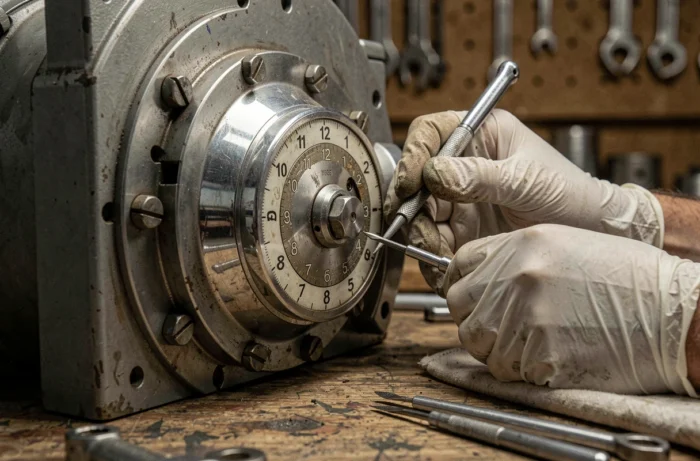
A qualified safe technician systematically prioritizes non-destructive opening techniques, without damaging the mechanism or the door. This technique preserves the safe and allows for its reuse after repair. In contrast, a destructive opening (drilling, grinding) renders the safe unusable and may pose a problem with the insurer if the model is no longer marketed.
Several elements allow for the evaluation of a professional before entrusting them with the intervention:
- The systematic request for proof of ownership or identity before any opening (a serious professional refuses to intervene without verification)
- The ability to identify the brand and model of the safe to adapt the intervention technique
- The provision of a written estimate before the start of the work, mentioning the type of opening envisaged (non-destructive or destructive)
- The possession of professional liability insurance covering potential damages to the safe and its contents
Preventing Safe Locking: The Technical Gestures That Matter
The maintenance of a safe is rarely mentioned in user manuals beyond a generic paragraph. A few concrete gestures significantly reduce the risk of malfunction.
Replacing the batteries of an electronic safe at least once a year, even if the low battery signal has not been triggered, avoids the majority of lockouts. Cheap or partially discharged batteries cause erratic malfunctions that are difficult to diagnose.
For mechanical locks, a light cleaning of the cylinder with a dry air spray, once or twice a year, prevents dust accumulation. Using the backup key (provided with most electronic safes) at least once a quarter ensures that this emergency measure remains functional when needed.
Keeping the documentation of the safe (serial number, certificate of conformity, manufacturer’s contact details) in a location separate from the safe itself significantly accelerates any repair procedure or contact with customer service.
The increase in burglaries observed during the summer, particularly in Île-de-France and the southeast of France, reminds us that a safe only fulfills its function if it remains operational. A safe that has been locked for months, which its owner postpones repairing, represents a false sense of security that can be costly in the event of a break-in.