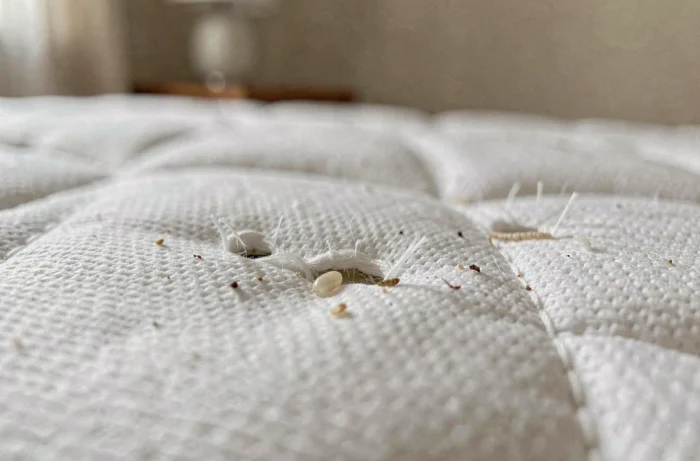
Small brown, fuzzy larvae moving along a mattress seam, a translucent shed skin caught in the fabric, itching when you wake up with no visible bite marks: these signs often point to carpet beetle larvae. This beetle lays its eggs in dark corners, and its larvae feed on animal fibers, hair, and dead skin. Spotting them early can prevent them from spreading throughout the bedroom.
Larva on the mattress or infestation elsewhere in the room: the distinction that changes everything
Finding a carpet beetle larva on a mattress does not mean the mattress is the source of the infestation. This is the most common misconception. The larvae move around and may crawl in from a rug, under a piece of furniture, or from a nearby closet.
UC IPM (University of California) recommendations emphasize that larvae hide in hard-to-inspect corners and that removing their food source may be enough in many cases. The mattress may simply be one stop along their route.
To find out whether the mattress is actually harboring a colony, inspect the seams, fabric folds, and underside. If you find a carpet beetle larva in a mattress along with several shed skins and small holes in the ticking, the source is probably there. A lone larva, with no shed skins or fabric damage, has likely come from elsewhere.
Have you spotted an adult near the window? According to UC IPM, adults feed on pollen and nectar outdoors. A lone adult at the window does not prove that the mattress is infested. It is the larvae that damage textiles, not the adults.

Signs of carpet beetle infestation on a mattress: what to look for
A carpet beetle larva is a few millimeters long, with an elongated, golden-brown body and bristles (fine hairs) visible to the naked eye. These hairs immediately distinguish it from a bed bug, which has a flat, hairless body.
Physical signs to look for
Larvae leave behind clear evidence. Here are the three types of traces to inspect:
- Shed skins (exuviae): small, translucent larva-shaped skins, often caught in mattress seams or between the box spring and bed frame. Several shed skins in the same spot indicate that the larvae have been there for some time.
- Tiny holes in fabric: the larvae nibble on animal fibers (wool, feathers, silk). Small, irregular holes in the mattress ticking or in a wool blanket on the bed indicate feeding activity.
- Small piles of fibrous debris: a powdery or grainy residue made up of droppings and chewed fibers may collect along seams or under the mattress.
Priority areas to inspect
Don’t limit your search to visible surfaces. Turn over the mattress and inspect the side that rests against the box spring. Run a finger along each side seam. Also check the bed frame if it has storage, the baseboards behind the headboard, and the edges of the nearest rug.
If the shed skins and damage are concentrated under a piece of furniture or in a closet corner rather than on the mattress, the main source is probably in that area, not in the bedding.
Itching and skin lesions: why they prove nothing
Many people discover carpet beetles after waking up with red marks. The first thought is often bed bugs. The reality is more nuanced.
Carpet beetle larvae do not bite or sting. In some people, their bristles can cause a skin reaction that looks like bites. A 2021 article in Emerging Infectious Diseases, a CDC journal, describes cases in France where these lesions were mistaken for bed bug or flea bites.
Diagnosis depends on physical evidence, not skin marks. A rash without larvae, shed skins, or holes in the fabric is not enough to draw a conclusion. Look for physical evidence before starting treatment.

Carpet beetle, clothes moth, or bed bug: quick ways to tell them apart
Confusing these three pests can lead to ineffective treatments. Use this table to tell them apart in seconds:
| Feature | Carpet beetle larva | Clothes moth (larva) | Bed bug |
|---|---|---|---|
| Appearance | Elongated, brown, hairy | Creamy white, smooth, with a silk case | Flat, oval, hairless, reddish-brown |
| Adult size | A few mm (adult is round and mottled) | Beige moth with a small wingspan | Flat, apple-seed-shaped |
| Bites | No (bristles may cause a reaction) | No | Yes, in lines or clusters |
| Textile damage | Irregular holes in animal fibers | Holes with silk threads | No textile damage |
| Droppings | Grainy, fibrous | Grainy, sandy | Small black spots (digested blood) |
One key point: if you find bloodstains on the sheet and black spots along the seams, you have bed bugs. If you find hairy shed skins and holes in wool, you have carpet beetle larvae. The two require different treatments.
First steps after finding carpet beetles in the bedroom
UC IPM expressly advises against spraying insecticide on clothing or bedding to treat carpet beetles. The approach relies on three measures: cleaning, vacuuming, and removing food sources.
Thoroughly vacuum the mattress, box spring, baseboards, and the undersides of furniture. Empty the vacuum bag or canister outdoors immediately afterward. Wash textiles that come into contact with the bed (sheets, covers, wool blankets) at a high temperature.
Removing the food source stops them from reproducing. The larvae feed on animal fibers, hair, pet fur, and debris from dead insects. Regularly cleaning hard-to-reach areas (under the bed, behind furniture) greatly reduces the risk of reinfestation.
If the infestation persists after two thorough cleaning cycles, the source is probably in an area you haven’t identified: the lining of an old coat, a collection of wool stored at the back of a closet, or a bird’s nest in the attic. Expand your inspection before repeatedly treating the mattress.