
Semi-skimmed cow’s milk contains about 3.3 g of protein per 100 mL, a benchmark that most plant-based drinks do not reach. Choosing the right milk to maximize daily protein intake requires going beyond this simple figure and examining the quality of amino acids, the actual protein density per serving, and the often-overlooked alternatives in standard comparisons.
Sheep’s milk and ultra-filtered milks: the densest protein options
Sheep’s milk remains the major absentee from public comparisons. With about 5.5 g of protein per 100 mL, it significantly surpasses both cow’s milk and goat’s milk, which are both around 3.3 g/100 mL. At equal volume, a glass of sheep’s milk therefore provides nearly 70% more protein compared to a glass of cow’s milk.
This protein density is accompanied by a richer lipid profile, making it a relevant choice for individuals looking to increase their overall caloric intake (athletes in a bulking phase, malnourished elderly people). For those monitoring their energy balance, the caloric trade-off should be included in the calculation.
Another category to consider is ultra-filtered milks enriched with protein, such as those marketed under the Fairlife brand. The ultrafiltration process concentrates proteins while reducing lactose, allowing for about 13 g of protein per 240 mL glass, which is double that of regular milk. This type of product is still not widely distributed in France, but its presence is increasing in specialized channels.
We recommend checking the proteins in cow’s milk according to Gourmand Sans Gluten for a detailed comparative table between different animal milks.
Amino acid profile: why not all milks are equal
The gross amount of protein is not enough. A protein-rich milk with an incomplete amino acid profile has limited physiological interest. The proteins in cow’s milk (casein and whey) contain all nine essential amino acids in proportions that are directly assimilable by the body.
Casein, which makes up the majority of proteins in cow’s milk, digests slowly and provides a prolonged supply of amino acids. Whey (lactoserum) acts more quickly and has a high concentration of leucine, the amino acid most critical for muscle protein synthesis.
Goat’s milk and sheep’s milk share this complete profile. Their digestibility differs slightly due to the size of casein micelles and the structure of fat globules, but in terms of amino acids, the coverage is comparable.
Plant-based drinks and limiting amino acids
Soy is the only legume whose drink offers an amino acid profile close to that of animal milks, with about 7 to 8 g of protein per 250 mL serving. Other plant-based drinks have marked deficiencies:
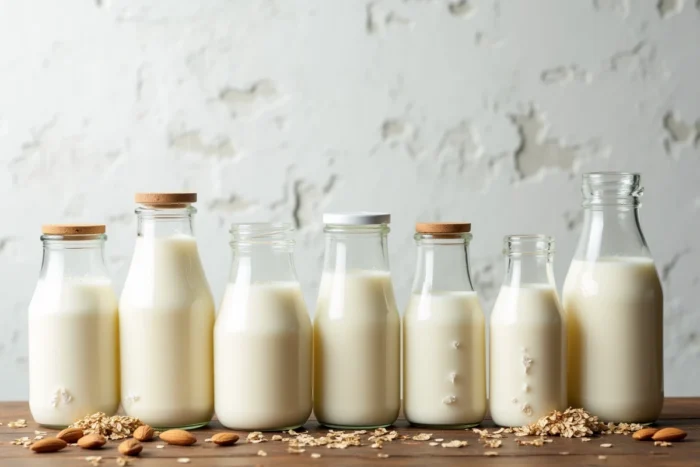
- Almond milk generally does not exceed 1 g of protein per 100 mL, with a deficiency in lysine.
- Oat milk has a similar profile, low in lysine and threonine, two essential amino acids.
- Rice milk is the lowest in protein and the least interesting in terms of amino acid quality.
Out of 23 plant-based drinks analyzed sold in France, only three exceed 3 g of protein per 100 mL. The rest fall well below, making the direct substitution of cow’s milk with a plant-based drink problematic in a protein maximization context.
Liquid milk or fermented dairy products: the actual protein density in daily life
Thinking only in terms of liquid milk is reductive. In a protein optimization strategy, thick fermented dairy products often surpass milk in protein density per serving consumed.
Plain Greek yogurt concentrates protein by draining whey. Its protein content far exceeds that of an equivalent volume of milk. Skyr, an Icelandic dairy product, shows comparable values. Both options also provide probiotics, an advantage absent from pasteurized or UHT milk.
Incorporating Greek yogurt or skyr into breakfast is a better replacement for a glass of milk when the goal is to increase protein intake without altering overall food volume. Milk kefir is a liquid fermented alternative, easier to consume for those who prefer drinking rather than eating with a spoon.

Choosing criteria based on the targeted protein goal
The best milk depends on the overall dietary context. We observe three typical profiles that guide the choice differently.
- Muscle goal (sports, recovery): prioritize ultra-filtered milk or, if unavailable, whole cow’s milk combined with whey powder. The leucine from whey directly stimulates post-exercise protein synthesis.
- General health goal (maintaining lean mass): semi-skimmed cow’s milk remains the most balanced choice in terms of protein/calorie ratio. Sheep’s milk is suitable if caloric intake is not a constraint.
- Strict plant-based goal: unsweetened soy drink is the only credible alternative. Complement with dietary sources of lysine (legumes, quinoa) to compensate for any marginal deficiency.
Skimmed milk, often presented as the ultimate protein choice, does offer a favorable protein/calorie ratio. Its absolute protein content remains identical to that of semi-skimmed milk: only the lipid fraction changes. The caloric gain is modest and does not always justify the taste sacrifice.
For a daily diet rich in protein, combining cow’s milk and thick fermented products remains the most effective strategy. Sheep’s milk and ultra-filtered milks offer interesting shortcuts for those looking to concentrate their intake in less volume. Plant-based drinks, except for soy, do not compete in the same protein category.