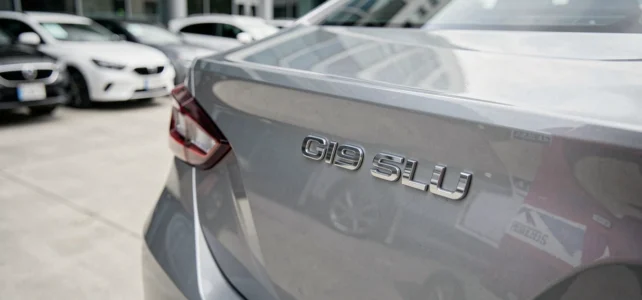
The acronym SR on a car does not refer to the S sticker intended for senior drivers. SR designates a trim or a sporty variant offered by several manufacturers, primarily in the abbreviated form of “Sport Rally” or “Sport Racing” depending on the brands. Confusing the two is common, but their technical and regulatory implications have nothing in common.
SR as a trim code: technical reading of the registration certificate
On the registration certificate (vehicle registration document), the vehicle’s trim appears in the commercial designation or in the national identification type code (CNIT). The suffix SR is included when the manufacturer has homologated a distinct variant of the base model, with different engine, chassis, or equipment characteristics.
We regularly observe that used vehicle buyers are unaware of this mention. However, it conditions the resale value, the compatibility of spare parts, and the calculation of the insurance premium. A SR model may feature a more powerful gasoline engine, recalibrated running gear, or a specific body kit, all of which affect maintenance costs at the garage.
To identify the exact trim of a vehicle, several methods exist:
- Consult the CNIT on the registration certificate and cross-reference it with the manufacturer’s database or an online VIN decoding service.
- Check the manufacturer’s plate (usually in the engine compartment or on the door pillar), which mentions the complete model code.
- Compare the standard equipment with the official technical sheet of the relevant model year, available from the brand’s network.
Knowing exactly what SR means on a car helps avoid unpleasant surprises during a transaction, especially in the used market where the trim directly affects the value.

SR variants at Nissan, Toyota, and Volkswagen: what changes under the hood
Each manufacturer assigns a different technical content to the SR badge. There is no unified standard in Europe or elsewhere. The same badge can cover mechanical realities that are far apart from one brand to another.
Nissan and the Sport Rally lineage
At Nissan, SR has historically been the abbreviation for “Sport Rally.” This trim translates to a reworked powertrain, often a direct-injection gasoline engine, paired with firmer suspensions and larger diameter wheels. The exterior design typically receives specific elements: rear spoiler, blackened grille, body-colored mirrors.
Toyota and the range logic
Toyota sometimes uses the SR badge to designate a mid-range trim with a sporty orientation. The content varies depending on the model and the sales region. In some markets, the SR version includes a limited-slip differential or specific driving modes, while in others it is limited to an aesthetic package.
Volkswagen and trim suffixes
At Volkswagen, the SR suffix does not appear as systematically as at Nissan. The German brand favors names like GTI, GTD, or R for its sporty variants. However, the SR code may appear in the internal technical description or on the registration certificate of certain models sold in Europe, designating a specific equipment level related to the chosen diesel or gasoline engine.
We recommend never relying solely on the badge affixed to the body. Only the decoded VIN confirms the actual trim of the vehicle.
SR and S sticker for seniors: two acronyms not to be confused
The confusion between SR (car trim) and the S sticker (voluntary signaling for senior drivers) fuels recurring discussions. The S sticker is a purely private device, notably carried by the association Signal Senior. No regulatory text mandates the S sticker on a vehicle, contrary to what some publications on social media might suggest.
Road safety authorities have labeled the rumors of an obligation for the S disc after a certain age as misinformation. Geriatricians also remind that driving ability is assessed based on individual capabilities, not on a sticker. This sticker remains a voluntary marker, without any specific legal framework.
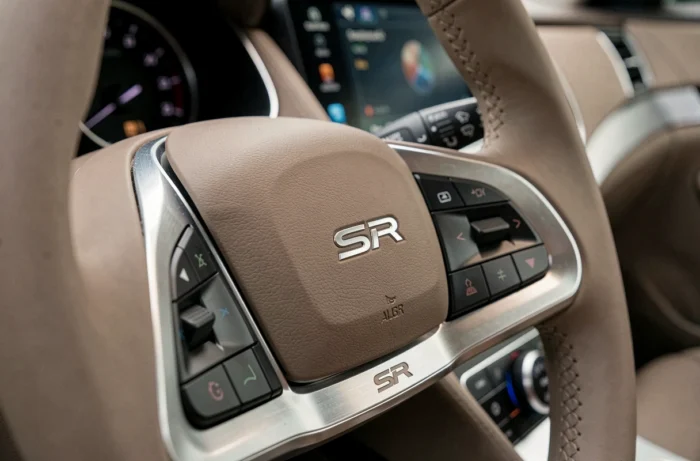
The SR badge on the body or the registration certificate has no relation to the driver’s age. It exclusively informs about the technical configuration and the trim level of the vehicle.
Check the SR trim before a used purchase
In the used market, a vehicle displayed in SR version is negotiated differently than a base model. The engine performance, type of gearbox, wheel design, and comfort equipment vary. Before signing, several points deserve methodical verification:
- Decode the VIN number through a specialized service to confirm that the trim matches the advertisement.
- Compare the list of standard equipment for the SR version of the relevant model year with what is actually present on the vehicle.
- Have the specific elements of the sporty variant (suspension, braking, exhaust) inspected by a competent garage, as their replacement costs significantly more than on a standard version.
- Check the maintenance history: a poorly maintained SR model quickly loses the mechanical advantage that justifies its higher purchase price.
The SR trim remains a legitimate selling point when the vehicle has been maintained according to the manufacturer’s recommendations. Otherwise, the badge guarantees nothing more than an exterior appearance.
The SR badge on a car summarizes in two letters a set of technical and aesthetic choices specific to each manufacturer. Precisely identifying the trim via the VIN and the registration certificate remains the only reliable approach, whether purchasing a Nissan, Toyota, Volkswagen, or any other brand using this code.