
The banana is one of the most consumed fruits in the morning. Easy to carry, filling, it ticks many boxes for a quick breakfast. The debate about bananas at breakfast comes up regularly, often from an alarmist angle that deserves to be nuanced.
Green banana or ripe banana: the degree of ripeness changes everything
Have you ever noticed that the texture and taste of a banana change radically between its greenish version and its brown-spotted version? It’s not just a matter of preference: the nutritional composition also transforms.
A slightly green banana contains more resistant starch, a carbohydrate that the small intestine does not digest. This starch arrives intact in the colon, where it nourishes the beneficial bacteria of the microbiome. It promotes the production of short-chain fatty acids like butyrate, which is associated with reduced inflammation and better integrity of the intestinal lining.
The slightly green banana also contains fructo-oligosaccharides (FOS), fibers with prebiotic effects that particularly stimulate Bifidobacteria. To fully understand the effects of bananas at breakfast, this distinction between green ripeness and advanced ripeness is a solid starting point.
In contrast, a very ripe banana concentrates more free sugars and less resistant starch. Its prebiotic effect decreases. It causes a quicker spike in blood sugar, especially when consumed alone and on an empty stomach. The blood sugar peak drops quickly, which can trigger a feeling of hunger within the hour that follows.
Blood sugar and banana on an empty stomach: why the meal context matters
The problem often pointed out by nutritionists does not concern the banana itself. It concerns the banana consumed alone, without other food. A fruit eaten in isolation releases its sugars quickly into the blood. The pancreas responds with a spike in insulin, followed by a drop that leaves the body craving energy.
This mechanism is not unique to bananas. It occurs with any carbohydrate-rich fruit eaten on an empty stomach without accompaniment. The banana is simply more concentrated in sugars than most other common breakfast fruits.
What slows down sugar absorption
Three levers can help slow this blood sugar rise:
- Proteins (plain yogurt, eggs, cottage cheese) slow gastric emptying and spread carbohydrate absorption over a longer duration.
- Fats (nuts like almonds or walnuts, peanut butter) add density to the meal and delay the passage of sugar into the blood.
- Additional fibers (oatmeal, chia seeds, whole grain bread) increase the volume of the food bolus and prolong digestion.
Recent literature on breakfast emphasizes the overall profile of the meal rather than the exclusion of a single food. A breakfast combining whole grains, proteins, and fibers significantly improves postprandial blood sugar, even in people with fragile blood sugar levels.
Potassium, fibers, vitamin B6: what the banana really brings in the morning
Reducing the banana to its sugar content ignores the rest of its composition. This fruit provides potassium, a mineral involved in regulating blood pressure and muscle contraction. It also provides vitamin B6, useful for the synthesis of neurotransmitters like serotonin.
In terms of digestion, the fibers in bananas (notably pectins) contribute to the proper functioning of transit. The banana remains one of the most convenient fruits to incorporate into breakfast, as long as it is not the sole component of the meal.
Some situations require more caution. People with irritable bowel syndrome may react to the FOS contained in bananas. Those suffering from kidney failure should monitor their potassium intake. In these cases, adjusting the quantity or choosing a fruit less concentrated in potassium may be relevant.

Balanced breakfast with a banana: concrete combinations
Rather than banning the banana, it is more useful to know how to consume it. Here are combinations that balance the meal:
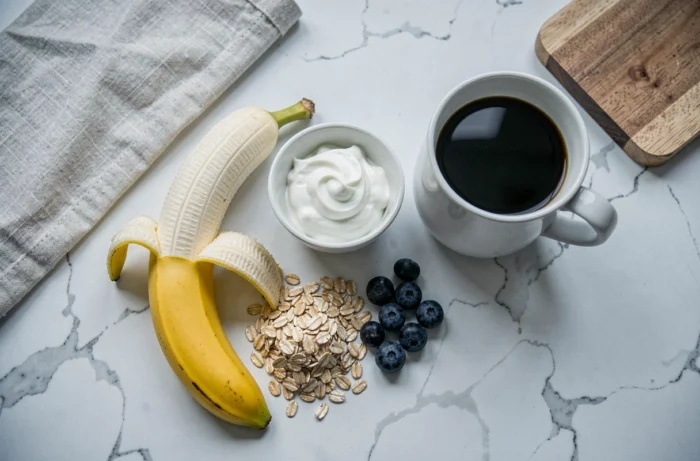
- Slightly green banana sliced into rounds in a bowl of oatmeal with plain yogurt. The fibers from the oats and the proteins from the yogurt slow down sugar absorption.
- Mashed banana on a slice of whole grain bread with a spoonful of almond butter. The fats and fibers from the bread prolong satiety.
- Whole banana accompanied by a handful of nuts and cottage cheese. The trio of proteins-fats-fibers limits the glycemic spike.
Choosing a not-too-ripe banana amplifies the prebiotic effect and reduces the load of quick sugars. A banana with yellow skin and a few green touches offers the best compromise between pleasant taste and favorable nutritional profile.
Varying morning fruits
Eating a banana every morning is not a problem in itself, but alternating with other fruits diversifies the intake of fibers and micronutrients. Berries, kiwis, or apples provide complementary polyphenols and soluble fibers that nourish other strains of the microbiome.
The question is not whether the banana is good or bad for breakfast. It is the meal as a whole that determines the effect on blood sugar, satiety, and digestive health. A well-chosen banana (not too ripe) and well accompanied (proteins, fats, fibers) remains a perfectly valid choice to start the day.