
The amino acid profile of a protein powder directly determines its biological value. Choosing a protein powder to boost performance involves balancing absorption speed, amino acid profile, digestive tolerance, and actual cost per gram of assimilated protein. Here, we detail the technical criteria that help make the decision.
Amino Acid Profile and Leucine: The Criteria That Labels Conceal
The leucine content drives muscle protein synthesis. A concentrated whey typically shows a higher leucine ratio than a single-source plant blend, but the comparison stops there if the complete amino acid profile is not examined.
We recommend systematically checking the distribution of BCAAs (leucine, isoleucine, valine) and the presence of methionine and lysine, two amino acids often deficient in single-source plant proteins. An incomplete amino acid profile limits anabolism even at high doses.
Pea-rice blends correct this imbalance through complementarity: peas provide lysine, while rice covers methionine. Therefore, seeking the best protein powder means reading the amino acid profile before looking at the total weight displayed on the container.
Whey Isolate, Hydrolysate, or Concentrate: Filtration and Digestive Tolerance
The filtration method determines the final purity of the product. Cold microfiltration (CFM) preserves the bioactive fractions of whey while reducing residual lactose. Ultrafiltration, which is less expensive, leaves more lipids and lactose in the finished product.
Micro-filtered isolate is suitable for those sensitive to lactose without resorting to a more expensive hydrolysate. The hydrolysate takes decomposition a step further: the peptides are pre-cut, which speeds up absorption but often alters the taste.
The concentrate remains relevant for athletes without digestive issues who seek cost control. The difference in absorption speed between concentrate and isolate does not significantly affect the anabolic response over the entire day, given equivalent total intake.
Additives and Sweeteners: What the Ingredient List Reveals
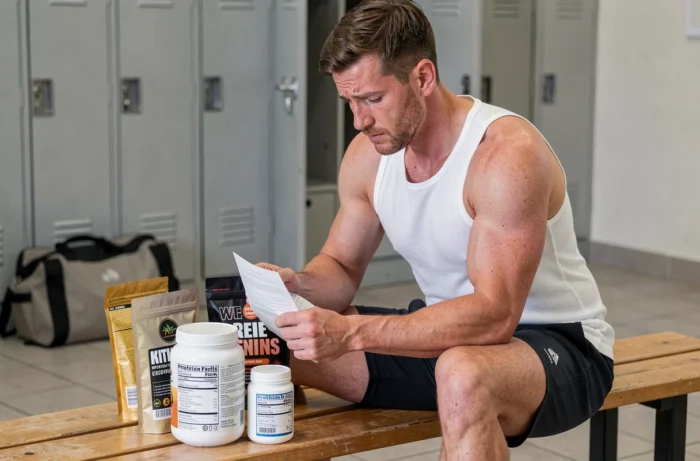
A high number of additives (thickeners, artificial flavors, multiple sweeteners) often indicates a lower quality raw material that the manufacturer seeks to compensate for in texture and taste. The most straightforward formulas display three to five ingredients.
- Check the position of the protein source in the list: it should be listed first, without a mixture of unquantified concentrate and isolate
- Identify the sweeteners (sucralose, acesulfame-K, stevia) and their number, as a combination of two or more can worsen gastric discomfort in some athletes
- Ensure the presence of third-party testing (independent laboratory analyses) guaranteeing the absence of heavy metals and compliance of the actual protein content with the stated content
Price per Gram of Actual Protein: Calculation and Common Pitfalls
Comparing the price per kilo of the container is not enough. A container priced attractively but containing only about sixty percent actual protein costs more per useful gram than a more concentrated premium isolate.
The method is straightforward: divide the total price by the number of grams of effective protein (not the net weight of the container). We observe that promotional formats (small packets, limited editions) often display a cost per gram of protein significantly higher than standard formats.
Another pitfall: “protein blends” that list whey isolate first but are supplemented with cheap concentrate without indicating the proportion. The absence of percentage by source in the blend is a warning sign.
Plant Proteins and Endurance: An Underestimated Use
Plant proteins are not just a substitute for vegetarian diets. Endurance athletes (running, cycling) benefit from pea-rice blends to support recovery without digestive heaviness during high-volume training phases.
The pea-rice complementarity provides an amino acid profile comparable to whey when the proportions are correctly calibrated. Some manufacturers add free leucine to fill the residual gap with whey.
A rarely covered point: the caloric density of a plant shake is often lower than that of a shake based on concentrated whey, which facilitates energy intake management during training load periods without excess calories.
Traceability and Transparency: What Differentiates Brands
The source of the milk (pasture, intensive farming) and the location of the processing plant influence the quality of the whey. Brands that publish their batch analyses (certificates of analysis by batch) offer a higher guarantee than those that rely on a generic label.
- Favor powders whose whey origin is mentioned (country, type of farming)
- Look for brands subject to regular third-party audits rather than self-declared quality
- Check that the announced protein content matches the published analysis results, as discrepancies of several points exist in the market
Choosing a high-performance protein powder relies on three concrete trade-offs: the verified amino acid profile, the filtration method suitable for one’s tolerance, and the price relative to the gram of actual protein. Packaging and flavor marketing come after these technical fundamentals.