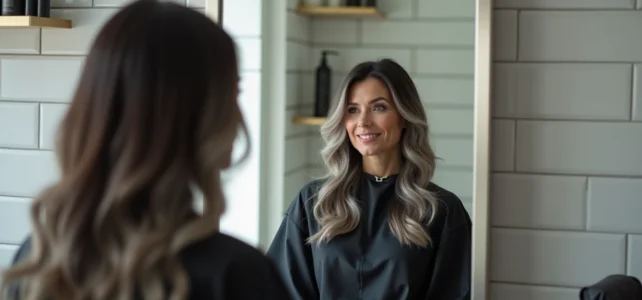
Grey blending on brown hair presents a technical problem that lighter bases do not encounter: the contrast between a white root and dark lengths creates a sharp, sometimes harsh demarcation. The technique involves blending these two areas through a play of intermediate shades, but on a brown base, the work of lightening and placement requires a much more thorough diagnosis than a simple balayage.
Grey blending on brown hair: why lightening changes everything
On blonde or light brown hair, a few ashy strands are enough to create a blend with the first white hairs. On a brown base, the distance between the pure white of the root and the dark brown of the lengths necessitates a controlled lightening step. This step is not trivial: it weakens the hair fiber.
Several specialized sources remind us that grey blending is still a lightening process, even if partial. On hair that has already been colored or sensitized by previous chemical treatments, the risk of breakage or porosity increases. The colorist must assess the complete history of the hair before applying any product.
An article detailing grey blending for brunettes on Atypik Beauté explains that the placement of light shades focuses on the upper third of the hair and the root area, unlike a traditional balayage that primarily works on the lengths and ends. This depth logic, specific to dark bases, aims to gradually connect the emerging white to the brown without a visible line of demarcation.
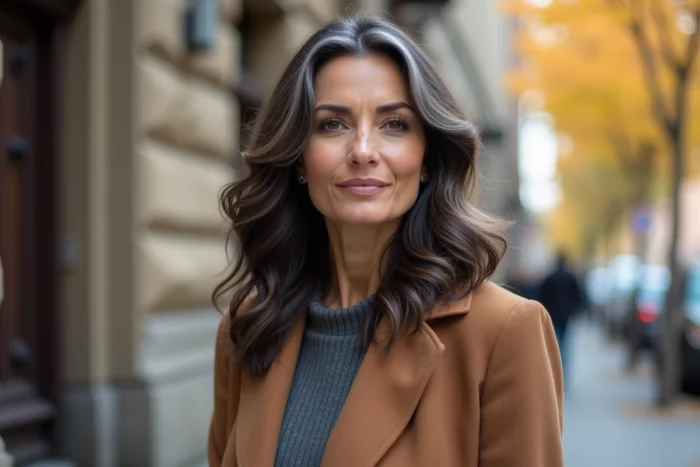
Cool or warm shades on a brown base: a technical choice, not aesthetic
On lightened brown hair, the yellowing of the lightened lengths largely dictates the orientation of the shades. A lightening base that turns orange or copper yellow requires cool corrections (ashy, pearl gray) to neutralize these unwanted reflections.
Champagne or beige shades, which are warmer, work better on brown hair that has never been colored, as their lightening base remains cleaner. On hair that has accumulated colorings, residual pigments complicate the result. Some colorists achieve a luminous blend in a single session, while others recommend two to three appointments to reach the target without damaging the fiber.
The percentage of existing white hairs also influences the choice. A white regrowth covering less than a quarter of the hair requires few light strands to create the illusion of blending. Beyond that, the work intensifies, and the shades must be more numerous to avoid a “striped” effect.
Maintaining grey blending on brown hair: the care that really matters
The commercial argument for grey blending is the reduction of touch-ups. On a brown base, this promise is partially validated. The regrowth is indeed less visible than with a covering color, but the result dulls if home maintenance is neglected.
Recent specialized content converges on three concrete care axes:
- A yellowing shampoo or mask (purple pigments) used once a week to neutralize yellow reflections on lightened strands and maintain a clean gray
- An enhanced hydration routine (keratin or amino acid-based masks) to compensate for the weakening caused by lightening, particularly on lengths that are already sensitized
- Protection against UV rays, in the form of a spray or leave-in treatment, as lightened hair is more vulnerable to solar oxidation that accentuates yellowing
Without these steps, grey blending on a brown base can lose its brightness within weeks. The patina applied in the salon (a semi-permanent color veil) gradually fades with each shampoo, and this is often when the result shifts from “bright salt and pepper” to “dull gray.”
Frequency of salon touch-ups
Most colorists recommend a salon visit every three to four months to refresh the patina and adjust the strands if necessary. This is less demanding than a classic coloring (monthly touch-up), but it is not the “zero maintenance” that some marketing content suggests.
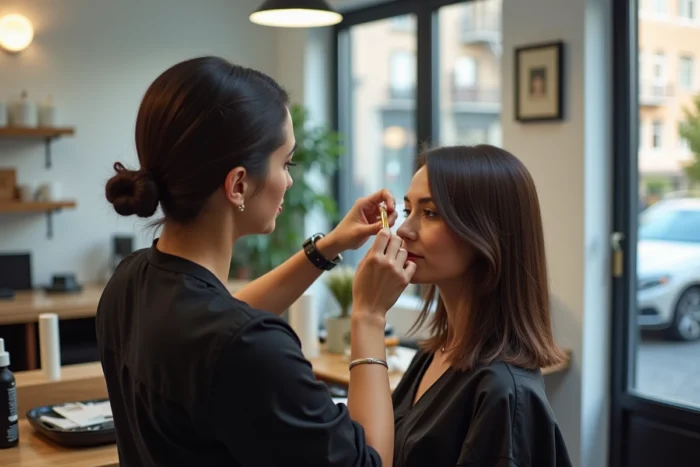
Grey blending and hybrid techniques: color melting, French blending
Grey blending is not the only approach to integrate white hairs into brown hair. Color melting works on a vertical fusion of colors without demarcation, layering several tones from dark to light. French blending, on the other hand, relies on very fine and closely spaced strands to mimic the natural growth of salt and pepper hair.
These techniques share a common goal: to space out touch-ups and make regrowth invisible. The available data does not allow us to conclude that one method consistently yields superior results to others on brown hair. The choice depends on hair texture, the volume of whites, and the desired effect.
What distinguishes these approaches is mainly the placement of the strands and the thickness of the sections worked on. A grey blending targets the face frame and the root, where the first whites most often appear. Color melting, however, covers a larger area and produces a more diffused gradient across the entire hair.
On brown hair, the common trap for all these techniques remains the same: poorly controlled lightening that turns orange, and insufficient maintenance that allows yellowing to settle in. A precise diagnosis of the hair history and regular monitoring of the patina condition the final result, regardless of the method chosen.