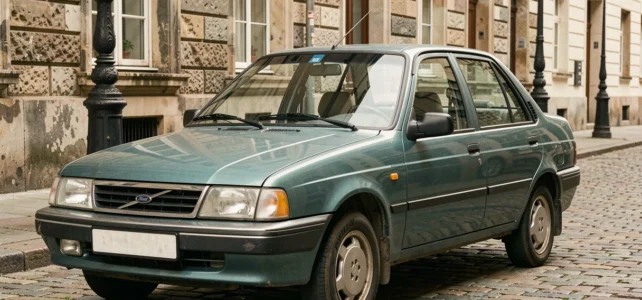
When looking for a part for a Matiz or coming across a Lanos in a junkyard, the question always arises: what exactly is Daewoo? A Korean manufacturer that has undergone five name changes, a spectacular bankruptcy, and whose production lines are still running today under other badges. Let’s take a look back at a trajectory that few automotive brands can claim.
Daewoo Damas and Labo: the last vehicles to carry the legacy until 2021
Most stories about Daewoo stop in 2002, when General Motors acquired most of its assets. It is often forgotten that two utility models, the microvan Damas and the Labo pickup, continued their careers in South Korea for nearly three decades.
The Damas served as a delivery vehicle for merchants and urban logistics. The Labo fulfilled the same role in a flatbed version. Their production was only halted in 2021, not because demand was waning, but because these models could no longer be brought into compliance with the stricter safety and emissions standards in Korea.
The site Dae Woo Automobile actually traces this often-overlooked longevity of the brand’s utility models. This case illustrates a concrete tension between industrial heritage and modern regulatory requirements.
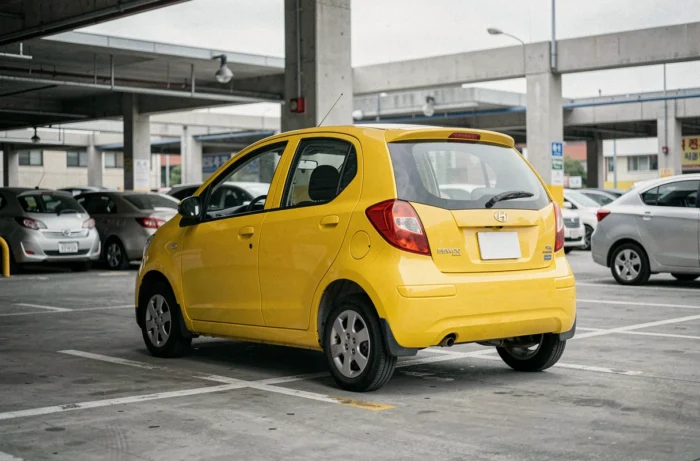
Five names for one manufacturer: the Daewoo timeline from 1937 to 1983
The entity that would become Daewoo was born in 1937 under the name National Motor, assembling Japanese trucks under license. Then, the renaming followed:
- Saenara (1962): assembly of Nissan Bluebird 310, the first step towards passenger cars
- Shinjin (1965): takeover of Saenara, then assembly of Toyota Corona between 1966 and 1972
- GM Korea, then Saehan: joint venture with General Motors starting in 1972, with Holden Torana and Opel Rekord D on the assembly lines
- Daewoo (1983): the Daewoo industrial group, already a shareholder, finally gives its name to the manufacturer
Until 1986, cars were assembled from imported parts. The brand did not design a 100% in-house vehicle until the late 1980s. This detail changes the perception of its early models: it is more about an assembler than a manufacturer in the strict sense during its first two decades.
Daewoo models sold in France: Matiz, Lanos, Nubira, and Leganza
In France, Daewoo was mainly visible in the late 1990s. The range was based on four main models, each targeting a specific segment of the automotive market.
Matiz: the entry-level city car
Designed by Giugiaro, the Matiz targeted tight budgets with an ultra-compact size. Its modest engine was sufficient for city driving. It was often seen as a first car or a secondary vehicle.
Lanos and Nubira: the core range
The Lanos (sedan and hatchback) and the Nubira (sedan and station wagon) occupied the compact segment. Their main selling point remained the price, significantly lower than European competitors for comparable equipment. The finish did not compete with a Peugeot 306 or a Volkswagen Golf, but the performance/cost ratio attracted a pragmatic clientele.
Leganza: the high-end attempt
Positioned against family sedans, the Leganza featured a design by Italdesign and a decent level of comfort. Feedback varies on this point, but the brand’s lack of recognition in Europe hindered its sales against established references.
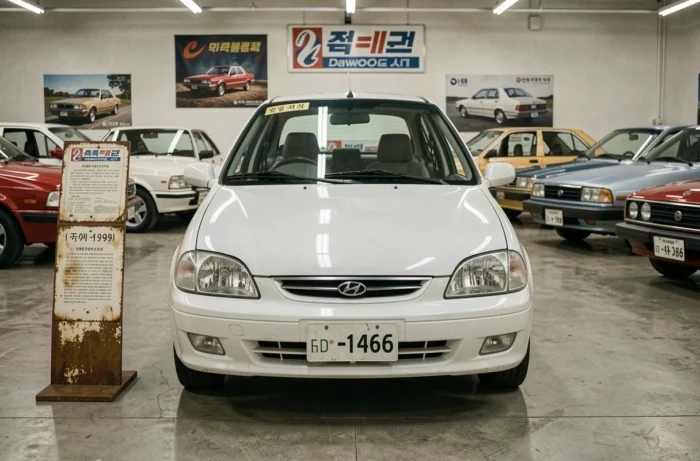
GM Korea: what the Daewoo factory produces today
The industrial legacy of Daewoo has not evaporated. GM Korea, the direct successor of Daewoo Motor, aims for an annual production of around 500,000 vehicles by 2026. The striking figure: over 95% of this production is for export, primarily to the United States.
The models coming out of these factories now carry Chevrolet and Buick badges:
- Chevrolet Trax and Trailblazer (small SUVs)
- Buick Envista and Encore GX (compact SUVs for the North American market)
The Korean assembly lines designed during the Daewoo era thus manufacture vehicles sold under American brands. This is a concrete case of an industrial platform that survives the disappearance of the original brand.
SsangYong, another branch of the Daewoo tree
Daewoo also acquired SsangYong Motor in 1997, just before the Asian financial crisis. After Daewoo’s bankruptcy in 1999, SsangYong changed owners several times (first to the Chinese SAIC, then to the Indian group Mahindra). The company is now called KG Mobility and is preparing a new Rexton for 2027, with a recent stake from the Chinese manufacturer Chery.
This trajectory shows that the bankruptcy of Daewoo redistributed industrial assets across Asia. Platforms, factories, and engineering skills did not disappear: they migrated to other entities that still exploit them.
Daewoo Automobile remains a case study in the global automotive industry. A manufacturer that went from simple licensed assembly to a full range sold across multiple continents, before collapsing under the weight of its debt. Its Korean factories are still operational, its former utility models only left the market recently, and its acquired subsidiaries continue to produce SUVs. The brand has disappeared from hoods, but not from assembly lines.