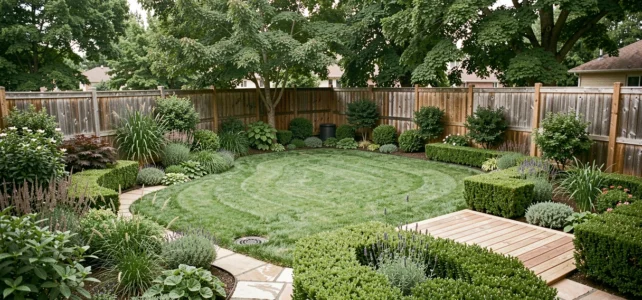
Designing around a septic tank requires adherence to a non-negotiable technical constraint: permanent access to inspection chambers, no heavy loads on the tank, and preservation of the drainage field. We recommend checking SPANC compliance before any project, as enforced rehabilitation can render a recent installation obsolete.
Here are ten concrete solutions, each tailored to a specific constraint, to reconcile landscaping ideas around a septic tank with the operational maintenance of the sanitation system.
1. Ground cover with spreading roots over the drainage field
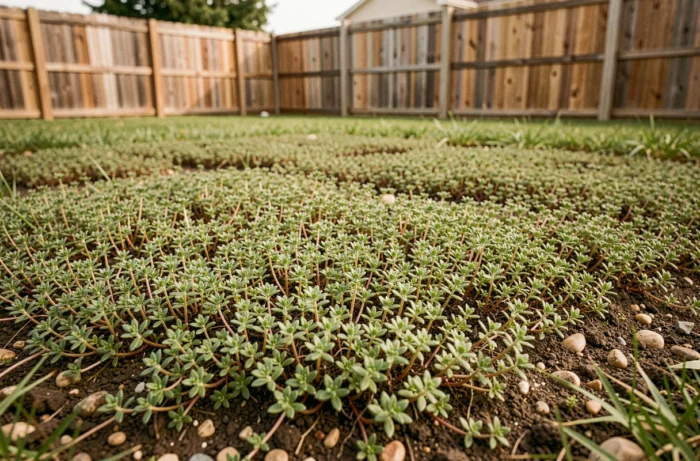
Drainage trenches do not tolerate deep-root competition well. A ground cover such as creeping thyme, sedum, or dwarf clover forms a dense mat with roots that remain in the top few centimeters of soil. This type of vegetation stabilizes the soil and limits erosion without obstructing the drains.
We observe that sedum, in particular, tolerates the poor filtering soils often found above a drainage area. It requires neither watering nor fertilization, thus avoiding any nitrogen input that could disrupt bacterial treatment.
2. Flowering meadow with direct seeding above the treatment field
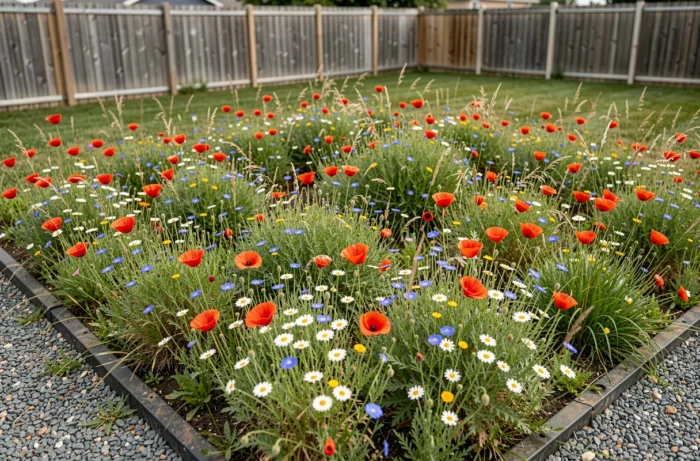
An annual flowering meadow (poppies, cornflowers, cosmos) is directly seeded onto the soil of the treatment field without deep soil work. Broadcast seeding avoids any earthworks that could damage the pipes.
Mowing once or twice a year is sufficient. The flowering cover visually masks the drainage area and attracts pollinators while allowing the soil to breathe – a necessary condition for the aerobic functioning of the system.
3. Removable wooden decking over inspection chambers
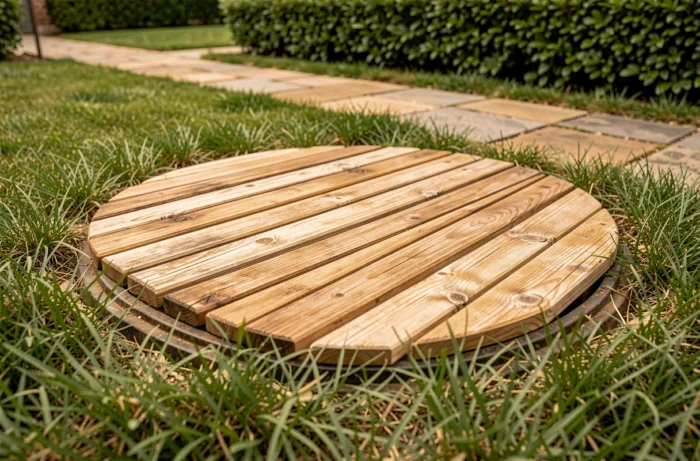
Inspection chambers must remain accessible for pumping and SPANC checks. Unfixed wooden decking, placed on a raised frame a few centimeters high, creates a clean surface without blocking access.
The decking can be removed in less than a minute on the day of the pump truck’s visit. We recommend using class 4 treated pine or larch, which resist soil moisture without leachable chemical treatment.
4. Ornamental grass bed around the tank
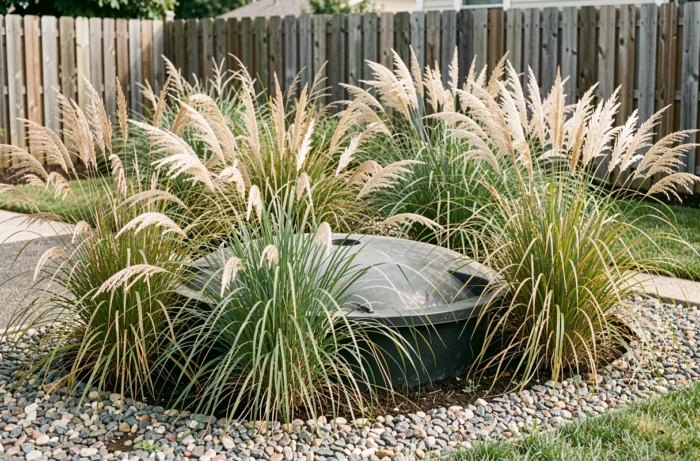
Miscanthus, pennisetum, or stipa should be planted at a safe distance from the tank (beyond the safety perimeter) to create a plant screen that conceals the installation. Their fibrous roots remain clustered and do not migrate laterally towards the pipes.
This type of bed acts as a natural curtain year-round. Deciduous grasses fold down at the end of winter, allowing for potential spring inspection access.
5. Mobile raised planters for above-ground vegetable garden
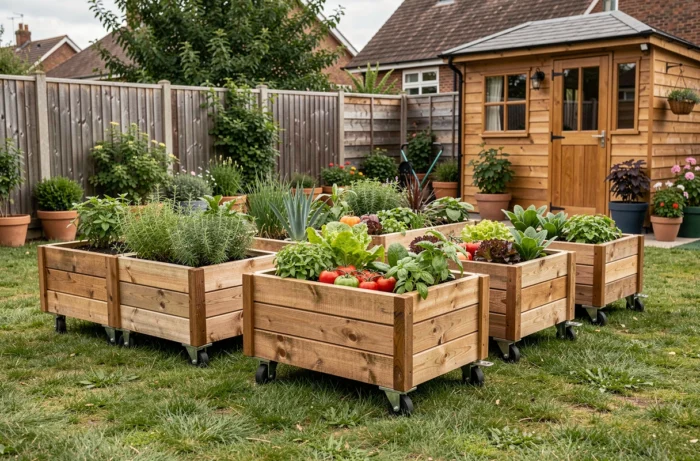
Planting vegetables directly in the soil above a septic tank is not recommended for health reasons. Mobile raised planters on legs or wheels allow for growing a garden nearby without any root contact with the system.
No roots should come into contact with the wastewater from the sanitation system. Above-ground containers with sufficient substrate depth are suitable for tomatoes, salads, or herbs, while remaining movable during maintenance operations.
6. Adjustable pedestal terrace without foundation
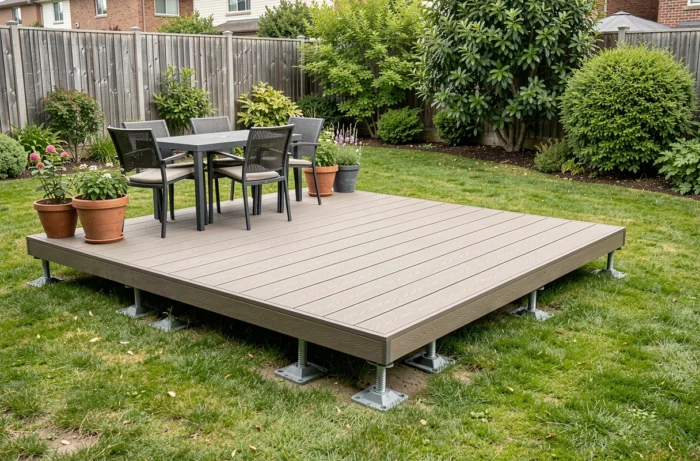
A traditional concrete slab terrace is incompatible with a septic tank. In contrast, a decking system on adjustable pedestals does not transmit any point load to the tank and can be disassembled section by section.
The pedestals are placed directly on compacted soil or on a geotextile. The pedestal system preserves soil ventilation, a critical parameter above a sand filter or drainage area. We recommend planning a layout that aligns removable joints with the inspection chambers.
7. Low evergreen hedge along the sanitation area
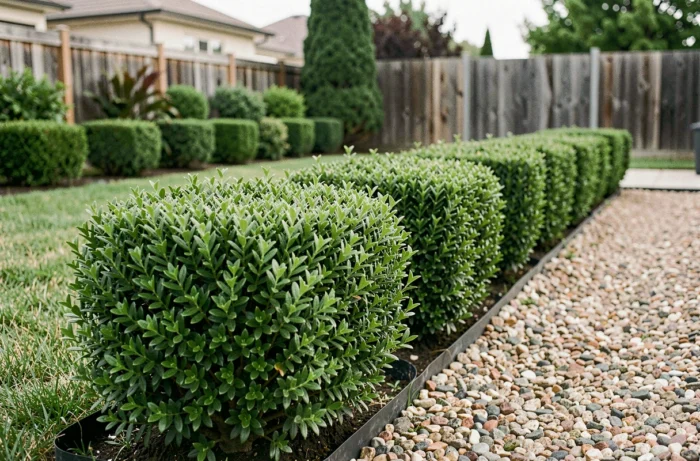
A hedge of boxwood, lavender, or rosemary planted along the edge of the sanitation area visually delineates the space without encroaching on the pipes. These species with shallow roots and moderate growth require only annual trimming.
The hedge’s layout also serves as a physical marker to prevent any heavy machinery from passing over the protected area. It is a simple aesthetic solution that requires minimal maintenance.
8. Mineral mulch and stepping stones for access path
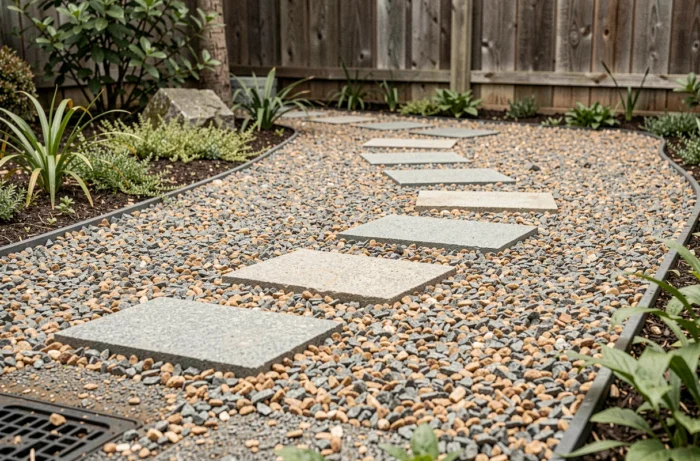
A gravel, pumice, or crushed slate mulch covers the area without compromising soil permeability. Stepping stones placed directly on the gravel guide pedestrian and technician traffic.
- Calibrated gravel (medium grade) facilitates drainage and prevents rainwater from pooling above the tank.
- Pumice, being lighter, is suitable for clay soils where weight must be kept minimal.
- Crushed slate provides a dark aesthetic finish that masks any potential moisture stains.
9. Decorative faux rocks to conceal access covers
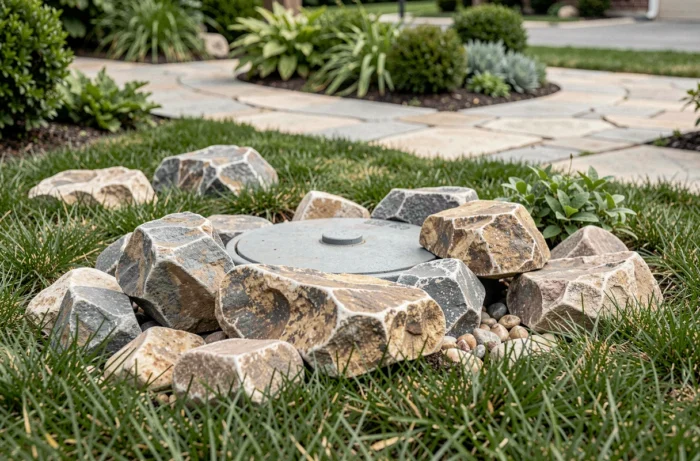
Inspection covers made of plastic or concrete are often the most visible element. Hollow, lightweight faux rocks made of polyester resin can be placed over them and removed by hand.
A faux rock typically weighs a few kilograms and exerts no significant pressure on the cover. We recommend choosing a ventilated model (with openings at the bottom) to avoid blocking the passive ventilation of the system.
10. Low-voltage solar lighting to mark the tank at night
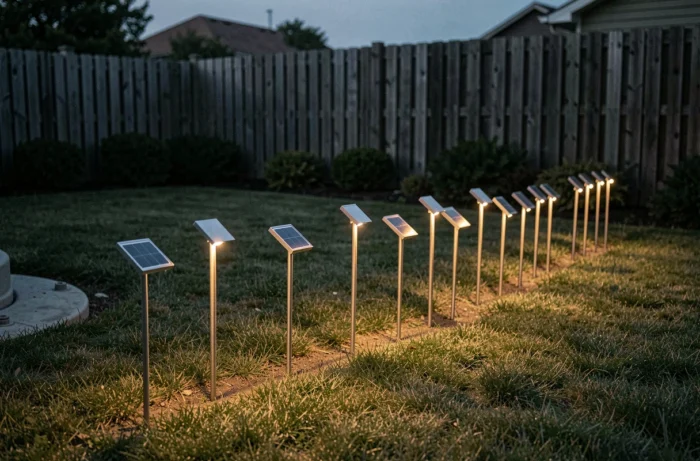
Solar stake lights are pushed into the ground around the tank without any buried wiring. They discreetly signal the perimeter to avoid overloading and prevent a vehicle or garden equipment from inadvertently parking on the area.
The absence of an electrical trench preserves the integrity of the pipes. Low-energy LED models operate autonomously and can be moved if the garden layout changes.
Each solution presented here adheres to a common principle: never compromise access, ventilation, or the drainage capacity of the system. Before starting any work, checking with SPANC that the installation is compliant remains the first step, as compliance modifications can alter the system’s layout and render a design unnecessary.